

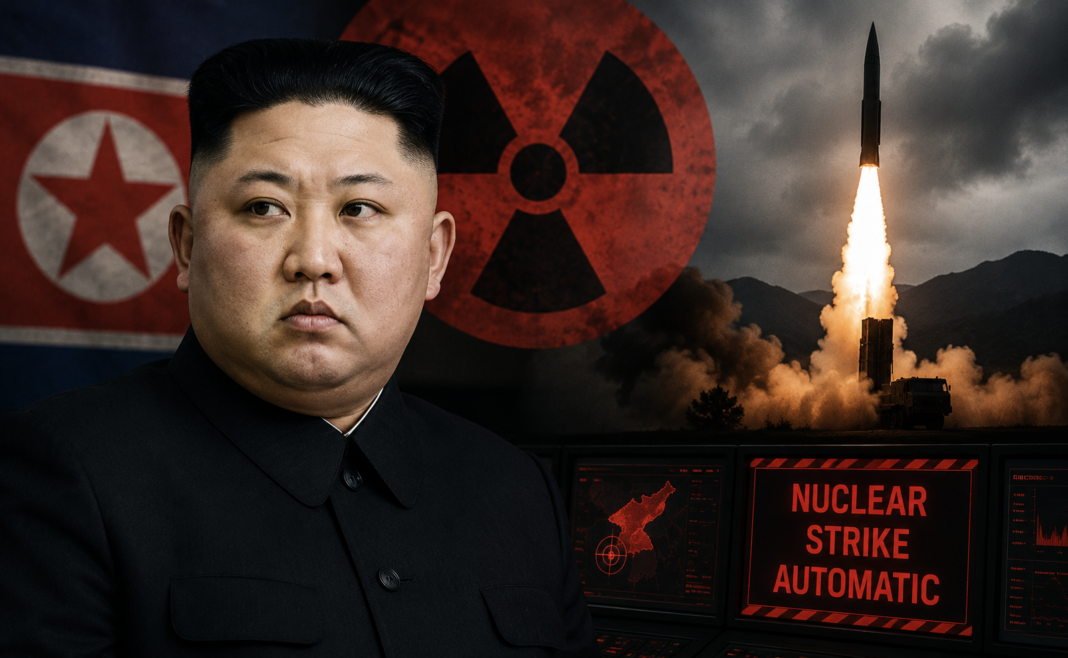
North Korea has reportedly made a major change to its nuclear doctrine by updating its constitution to allow an automatic nuclear strike if leader Kim Jong-un is killed or incapacitated during an attack.
According to reports citing South Korean intelligence officials, the revised law states that if North Korea’s nuclear command-and-control system is threatened by hostile forces, a nuclear strike must be launched “automatically and immediately.”
The move is being seen as a direct response to growing fears of so-called “decapitation attacks”—military operations designed to eliminate a country’s top leadership during conflict.
Why North Korea Made This Move
Analysts believe the decision was influenced by recent US-Israeli strikes on Iran, where top leadership figures were reportedly killed, raising alarm in Pyongyang over similar risks to Kim Jong-un and the North Korean command structure. Reports suggest the constitutional revision was formally adopted during the first session of the 15th Supreme People’s Assembly in March and later disclosed through South Korea’s National Intelligence Service (NIS).
This effectively creates what some experts describe as a “nuclear dead man’s switch,” ensuring retaliation even if the country’s supreme leader is unable to issue direct orders.
A Stronger Deterrence Strategy
North Korea has long maintained an aggressive nuclear posture, but this latest move formalizes an even more rigid retaliation policy.
The revised Article 3 reportedly states that if the command system governing the state’s nuclear forces is placed in danger due to hostile attacks, the strike must happen without delay. This signals that Pyongyang wants to remove any uncertainty for potential adversaries considering a leadership-targeting strike.
Security analysts say the policy is designed to strengthen deterrence by making it clear that any attack on Kim or the country’s top command would trigger immediate and devastating consequences.
Regional Tensions Continue to Rise
The development comes amid already high tensions on the Korean Peninsula, with North Korea continuing missile testing, military modernization, and increasingly hostile rhetoric toward South Korea and the United States.
Reports also indicate Pyongyang has recently removed constitutional language about peaceful reunification with South Korea, further signaling a harder strategic stance.
For neighboring countries and global powers, the revised nuclear doctrine adds another serious layer of concern in one of the world’s most sensitive security flashpoints.
Final Thoughts
While North Korea has often used strong military rhetoric, formally embedding automatic nuclear retaliation into constitutional law marks a significant escalation.
The message from Pyongyang appears clear: any attempt to remove its leadership could come at an extraordinary cost.
As geopolitical tensions continue to shift globally, this move could have major implications not just for East Asia, but for international security as a whole.