

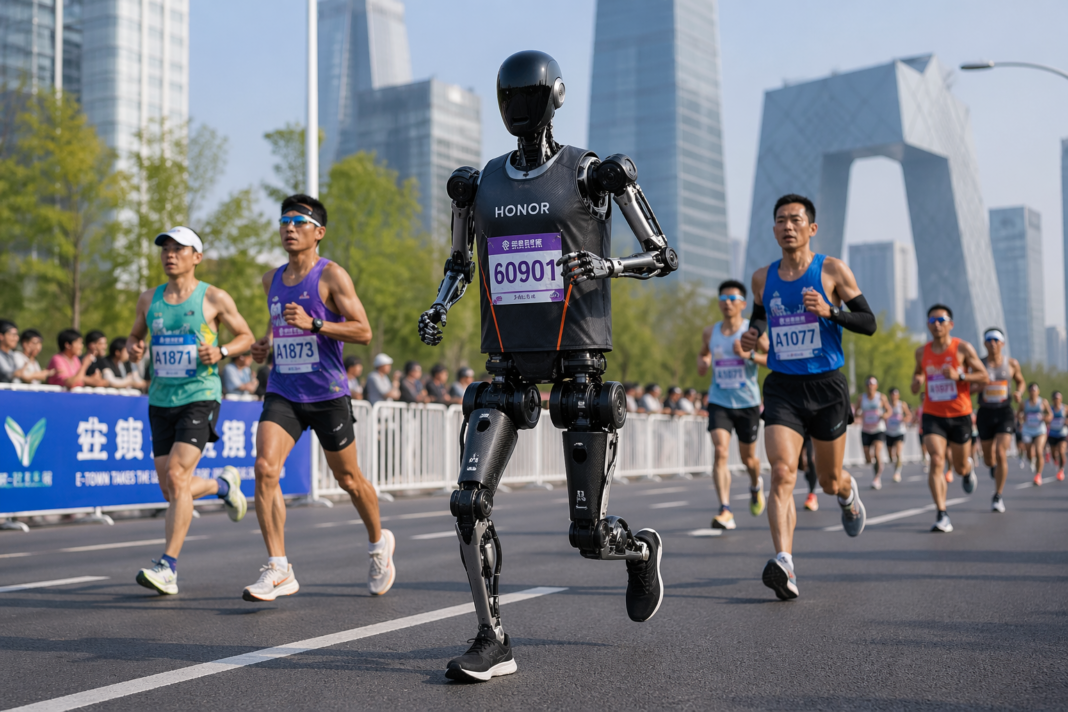
In a moment that felt straight out of science fiction, humanoid robots didn’t just join a race in Beijing—they dominated it.
At the 2026 Beijing E-Town Half-Marathon, dozens of advanced robots lined up alongside around 12,000 human runners. But what followed surprised even seasoned tech watchers: robots didn’t just keep up—they surged ahead.
🚀 A Record-Breaking Run
The standout performer, a humanoid robot developed by Chinese tech brand Honor, completed the 21-kilometer race in just 50 minutes and 26 seconds—faster than the human world record of 57 minutes.
To put that into perspective, last year’s fastest robot took over 2 hours and 40 minutes to finish the same distance. That’s not just improvement—it’s a massive leap.
Even more impressive? Nearly half of the robots in this year’s race navigated the course completely autonomously, without human control.
🤖 What Makes These Robots So Fast?
These aren’t your average machines. The robots are designed with:
- Human-like leg structures to mimic elite runners
- Advanced AI systems for balance and navigation
- Liquid cooling technology (inspired by smartphones) to prevent overheating
The result? A smoother, more natural running style that had spectators doing double takes.
⚡ From Chaos to Control
Interestingly, the first edition of this robot marathon wasn’t nearly as polished. Many robots struggled to finish, with frequent stumbles and technical glitches.
This year, while a few robots still tripped or veered off course, the overall performance showed just how quickly the technology is evolving.
🌍 Why This Matters
This isn’t just about robots running fast—it’s about what they represent.
Events like this are real-world testing grounds for robotics, pushing advancements in:
- Mobility and endurance
- Autonomous decision-making
- Energy efficiency and cooling systems
Experts believe these breakthroughs could soon translate into practical uses—from factory automation to rescue missions in hazardous environments.
🇨🇳 China’s Growing Tech Momentum
The marathon also highlights China’s growing focus on robotics as a key industry. With over 100 teams participating this year—up from just 20 last year—the country is rapidly scaling innovation in humanoid AI.
💡 The Bigger Picture
While robots beating humans in a race might sound like a headline-grabber (and it is), the real story is about progress.
We’re witnessing a shift where machines are no longer limited to repetitive tasks—they’re learning to move, adapt, and perform in dynamic, real-world environments.
And if a half-marathon is anything to go by, the pace of innovation is only accelerating.