
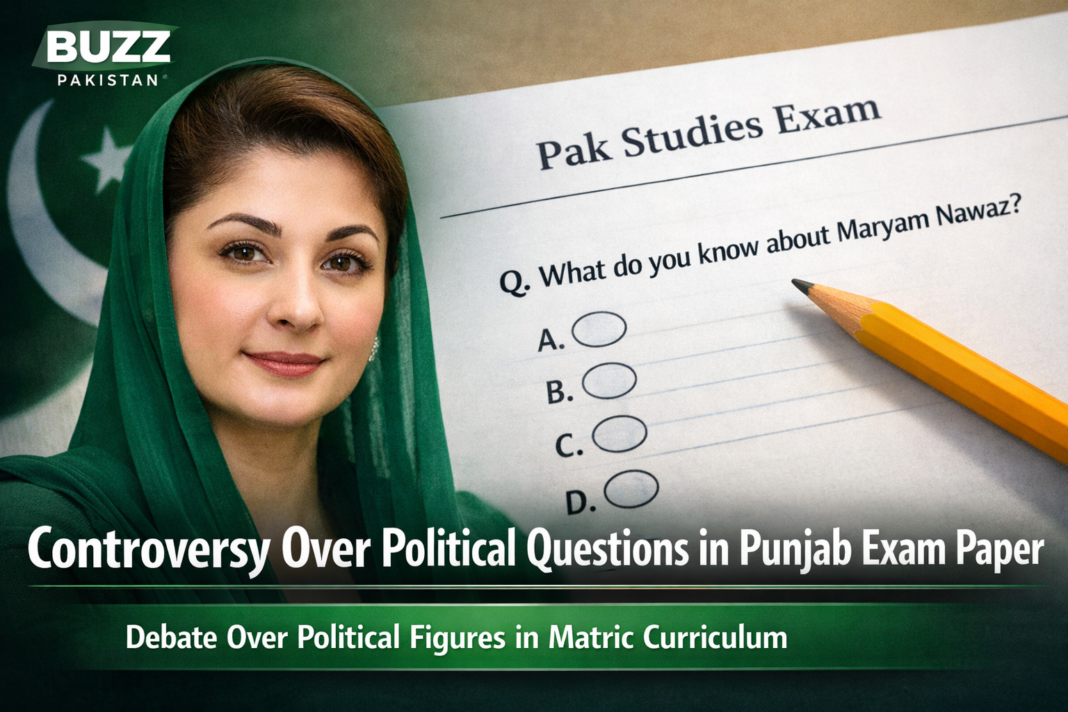
A recent matriculation exam in Punjab has stirred conversation across Pakistan after students were asked about prominent political figures in their Pak Studies paper. The inclusion of such questions has reignited a long-standing debate about the role of politics in school curricula.
What Happened in the Exam?
According to students and teachers, the exam paper included questions asking candidates to describe or give their opinion on personalities such as Maryam Nawaz Sharif, Kulsoom Nawaz, and Shehbaz Sharif.
These questions were based on a revised textbook introduced in the 2025 academic year, making 2026 the first time such content appeared in board exams.
Interestingly, the same chapter also includes figures like Zulfikar Ali Bhutto, Nusrat Bhutto, Fahmida Mirza, and Bilquis Edhi—suggesting a broader attempt to highlight influential personalities from different eras.
Why the Controversy?
The reaction online and within academic circles has been mixed.
Some critics argue that including current political figures in textbooks risks promoting a particular political narrative, especially when students are asked to express opinions rather than just recall facts.
On the other hand, the government has defended the content, stating that the chapter was designed to highlight the contributions of notable women in Pakistan, not to promote any specific political agenda.
Is This Something New?
Experts say the connection between curriculum and state narrative in Pakistan is not new.
Education expert Dr. Aneesa Mehdi points out that during the era of General Zia-ul-Haq, textbooks emphasized ideological alignment, often presenting state policies in a positive light.
Later, under Pervez Musharraf, reforms were introduced to make content somewhat more balanced, though the state perspective largely remained.
During Imran Khan’s tenure, the “Single National Curriculum” aimed to standardize education nationwide, though it too faced criticism on various fronts.
Are There Any Clear Rules?
Since the 18th Amendment, education has been a provincial subject, meaning each province develops its own curriculum through textbook boards.
While national guidelines encourage content to be factual, balanced, and unbiased, there is no strict law that prohibits the inclusion of sitting political leaders.
According to education analyst Dr. Salman Ali, the real goal of education should be to promote critical thinking and fact-based understanding—something that remains central to this ongoing debate.
The Bigger Question
This issue goes beyond one exam paper. It raises a broader and important question:
Should school curricula remain strictly neutral, or should they reflect contemporary political and social figures as part of national awareness?
As discussions continue, this moment may push policymakers toward clearer guidelines and greater transparency in curriculum development.