
Trump Mocks India Again, Claims Seven “Brand-New Planes” Lost to Pakistan
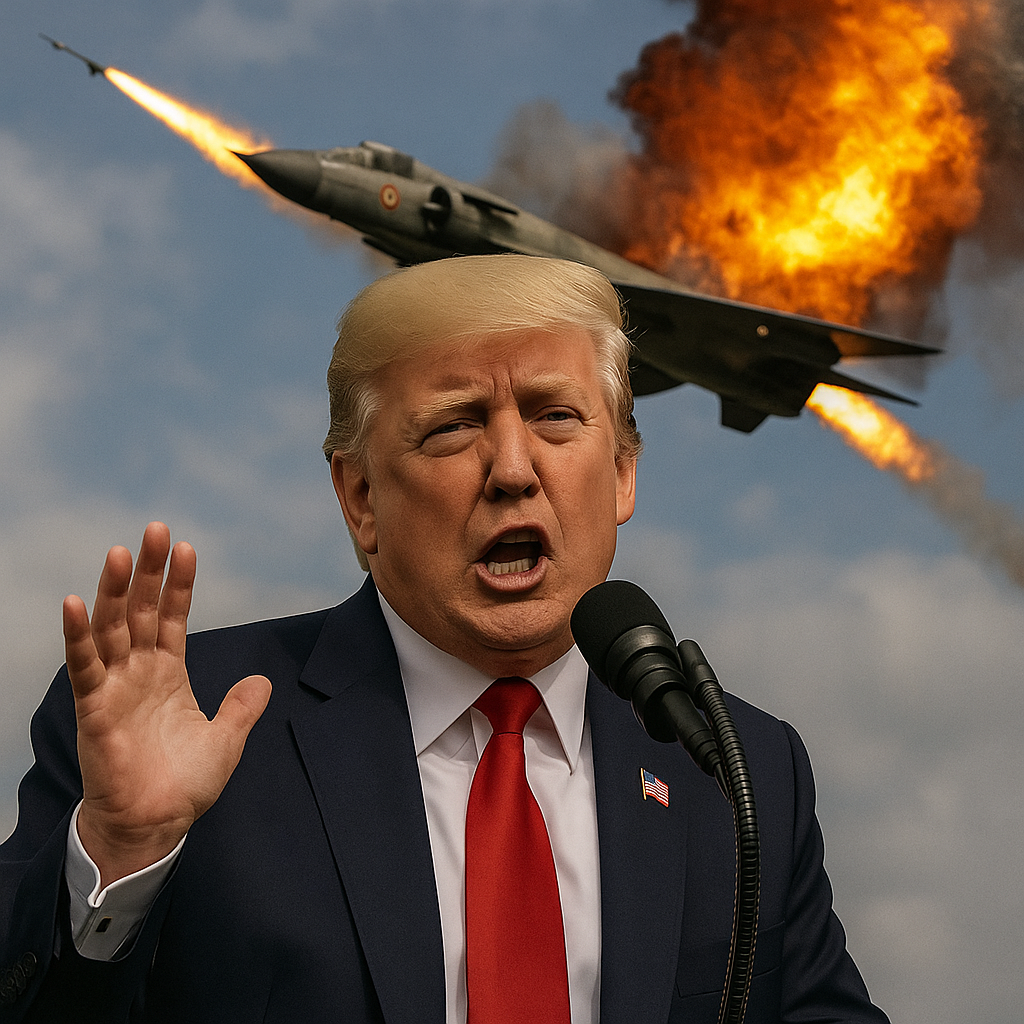
Former U.S. President Donald Trump has once again reignited controversy — this time by recalling that India lost seven “brand-new, beautiful planes” to Pakistan during their recent conflict. His bold claims, delivered at a public gathering, have stirred both political and diplomatic circles, especially across South Asia.
Trump’s Claim: “I Stopped a War in 24 Hours”
In his trademark dramatic tone, Trump claimed that India and Pakistan were “ready to go at it,” and that his direct intervention stopped a full-scale war. According to him, the two nuclear powers were moments away from disaster when he stepped in, warning both that the U.S. would end all trade if they continued fighting.
He further boasted that within 24 hours, both nations backed down — crediting his tariff-based pressure tactics for restoring peace. Trump also said he threatened to impose 100% to 200% tariffs as leverage to stop the escalation.
The May 2025 Escalation: What Actually Happened
The confrontation between Pakistan and India in May 2025 was one of the most dangerous in years.
Following a deadly attack in Indian-administered Kashmir, tensions erupted across the border, leading to air and ground exchanges, drone operations, and missile alerts on both sides.
Pakistan claimed it shot down several Indian fighter jets — including newly inducted aircraft — while India maintained that the losses were exaggerated. The official tally was never independently verified, and both sides presented sharply different versions of the events.
“Seven Planes” — Symbol or Statement?
Trump’s “seven planes” remark quickly caught global attention. While his exact figure remains unconfirmed, the symbolism is powerful.
For Pakistan, it reinforces the idea of military strength and defensive capability. For India, it is seen as an attempt to undermine its regional dominance and cast doubt on its airpower narrative.
Trump’s language — describing the planes as “brand-new” and “beautiful” — added his usual flair but also raised eyebrows. Many analysts see it as a deliberate exaggeration, designed to boost his image as a crisis manager on the world stage.
The U.S. Mediation Angle
Trump claimed that his personal call to both leaders — coupled with trade threats — led to an immediate ceasefire.
However, official accounts from both countries credit direct communication between their militaries for de-escalating the situation, not U.S. intervention.
Still, the idea of Trump stepping in as a peacebroker plays well for his political image back home. It fits his campaign narrative of being a “tough negotiator” who can stop wars through deal-making rather than diplomacy.
Why Pakistan Might Welcome the Narrative
Trump’s statement indirectly validates Pakistan’s version of the 2025 skirmish.
If the story gains traction internationally, it could support Islamabad’s claim that it held the upper hand during the conflict.
Possible advantages for Pakistan:
- Enhances Pakistan’s image of military success and deterrence capability.
- Positions Pakistan as a key player in U.S. foreign-policy conversations.
- Provides narrative leverage in future diplomatic or defense discussions.
Potential risks:
- Overreliance on foreign narratives could invite scrutiny if evidence doesn’t match.
- India’s strong diplomatic rebuttals could escalate tensions again.
- It may shift focus from Pakistan’s own peace efforts to Trump’s self-promotion.
Why India Finds It Uncomfortable
For India, Trump’s comments are politically sensitive. The idea that its modern air fleet suffered significant losses and that a U.S. leader intervened to stop the war challenges New Delhi’s strategic narrative.
It undermines the image of a self-reliant regional power and adds fuel to Pakistan’s domestic confidence.
If Trump’s version spreads globally, India risks losing control of its story in international media and diplomatic circles.
Trade, Tariffs, and the “Deal Diplomacy” Mindset
Trump’s remarks reflect his belief that economic leverage can replace traditional diplomacy. He argues that by weaponizing trade — through tariffs and sanctions — conflicts can be prevented more effectively than through military alliances.
While that view fits Trump’s political persona, it oversimplifies South Asia’s deeply rooted disputes.
The India-Pakistan rivalry is shaped by history, ideology, and security concerns, not trade alone.
Still, the idea that economic pressure could serve as a peace tool is gaining quiet traction among policymakers watching the region’s fragile balance.
The Bigger Picture: Narratives, Not Just Battles
Modern conflicts are no longer fought only on the battlefield — they’re fought in media and public perception.
Trump’s statement, whether accurate or not, shifts the spotlight from facts to narratives. It turns the India-Pakistan conflict into a global talking point once again, shaping public opinion and influencing international diplomacy.
Both nations now face the challenge of controlling the narrative — proving credibility while avoiding escalation.
For Pakistan, the claim adds prestige.
For India, it presents a test of restraint and image management.
What Lies Ahead
For Pakistan, Trump’s statement is an opportunity — but also a responsibility. It can reinforce confidence, but it must be paired with mature diplomacy and fact-based communication to sustain credibility.
For India, the focus will likely be on reaffirming its sovereignty and managing external narratives.
Both sides need to avoid letting political statements from foreign leaders derail future peace efforts.
As for Trump, his “seven planes” claim may be more about politics than proof — but it has once again reminded the world how fragile South Asia’s peace truly is.