

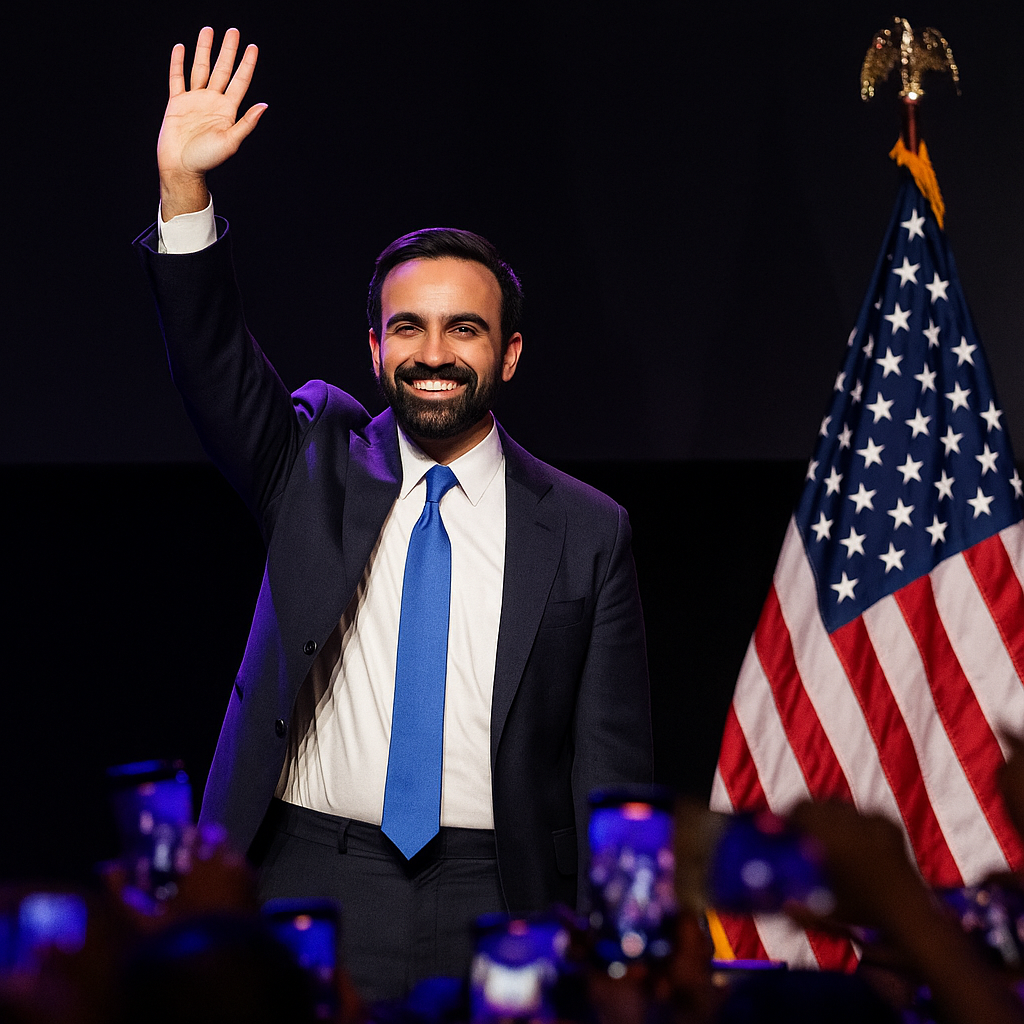
In a ground-breaking moment for American politics, Zohran Mamdani, a 34-year-old progressive politician, has been elected as the Mayor of New York City, marking a series of historic firsts — the city’s first Muslim mayor, first South Asian mayor, and youngest in over a century. His victory signifies a seismic shift in New York’s political landscape, driven by a promise of hope, equity, and systemic reform.
A Journey from Kampala to Queens
Born in Kampala, Uganda, in 1991 to South Asian parents, Zohran Mamdani’s journey embodies the quintessential immigrant story. His family, having faced displacement during political unrest, moved to the United States when he was just seven years old. Settling in Queens — one of New York’s most ethnically diverse boroughs — Mamdani was deeply influenced by the struggles and resilience of immigrant communities that form the backbone of the city.
After completing his education in Africana Studies, Mamdani immersed himself in community work before entering politics. In 2020, he was elected to the New York State Assembly, representing District 36 in Queens. His tenure was marked by strong advocacy for housing justice, public transportation accessibility, and social equity — all themes that became the foundation of his mayoral campaign.
The Campaign That Redefined New York Politics
Mamdani’s campaign was fueled by an army of volunteers, grassroots donations, and a message that resonated with working-class New Yorkers. His slogan, rooted in “making the impossible possible,” reflected a vision that challenged traditional power structures in city politics.
He ran on a bold progressive platform that included:
- Free public bus transportation to promote sustainable mobility and economic access.
- A rent freeze to combat soaring housing costs.
- Raising the city’s minimum wage to $30 per hour by 2030.
- Increasing taxes on corporations and the ultra-wealthy to fund social services.
- Expanding affordable housing and healthcare programs for low-income families.
His opponents — including former governor Andrew Cuomo, who ran as an independent, and Republican candidate Curtis Sliwa — dismissed his ideas as impractical. But Mamdani’s campaign tapped into the frustration of ordinary citizens struggling with inflation, housing insecurity, and stagnant wages. His clear stance against political elitism and his unifying message of inclusivity struck a chord across communities.
When election night arrived, Mamdani’s decisive victory stunned many observers but delighted millions who saw in him a reflection of New York’s diverse soul.
A Symbol of Representation and Change
For many, Mamdani’s victory is more than just a political win — it’s a cultural milestone. He now represents the millions of Muslims, South Asians, and immigrants who have long felt invisible in mainstream American politics.
In his emotional victory speech, Mamdani thanked New Yorkers for “believing that hope still has a place in politics.” He spoke about the unsung heroes of the city — the Yemeni shopkeepers, Pakistani cab drivers, Caribbean nurses, and Mexican construction workers — who keep New York alive every day but rarely see their struggles reflected in policy.
Mamdani’s identity as a Muslim, immigrant, and child of refugees gives his leadership a powerful symbolic weight. He represents a new generation of American leaders who bridge multiple identities while advocating for inclusive progress.
Challenges on the Horizon
As he prepares to assume office on January 1, 2026, Mamdani faces immense challenges. Turning campaign promises into policy in a city as complex as New York will test both his leadership and his coalition-building skills.
Key challenges include:
- Economic management: Implementing progressive taxation and free transit without straining the city’s finances.
- Housing crisis: Delivering on his promise of affordable housing amid record-high rents.
- Political resistance: Navigating opposition from centrist Democrats, business lobbies, and state-level officials skeptical of his reforms.
- Federal tensions: Managing relations with Washington, especially after friction with former President Trump during the campaign.
Despite these hurdles, Mamdani’s emphasis on transparency, people-first policies, and participatory governance may redefine what urban leadership looks like in America’s largest city.
Global Significance and Impact on the Muslim & South Asian Diaspora
Zohran Mamdani’s election reverberates far beyond New York. For Muslims, South Asians, and immigrant communities around the world — including Pakistan — his success is a source of immense pride and inspiration.
In a time when Islamophobia, racial bias, and anti-immigrant sentiment still linger across Western societies, his victory serves as a reminder that persistence, authenticity, and grassroots connection can overcome prejudice. Mamdani’s ascent illustrates how the children of immigrants can not only integrate but lead — shaping policy in some of the most influential cities on the planet.
For Pakistanis, this moment carries symbolic significance. Many Pakistani-Americans have played pivotal roles in civic and business life in the US, but few have reached such high political office. Mamdani’s success may ignite new political ambitions among the diaspora, encouraging greater participation in governance and public service.
The Road Ahead
Zohran Mamdani enters office at a defining moment — a city still recovering from economic disparities, housing shortages, and deep cultural divides. His leadership will be watched closely not only in the United States but across the world.
If he succeeds in transforming his progressive ideals into tangible results, Mamdani could become a model for the next generation of urban leaders globally — proving that politics driven by compassion, inclusion, and equality can indeed work in practice.
But beyond policies and programs, his story itself is a triumph — the journey of a young boy who fled a dictatorship, grew up in a working-class neighbourhood, and rose to lead one of the world’s greatest cities. It’s a testament to hope, to democracy, and to the belief that leadership can emerge from the most unexpected places.