

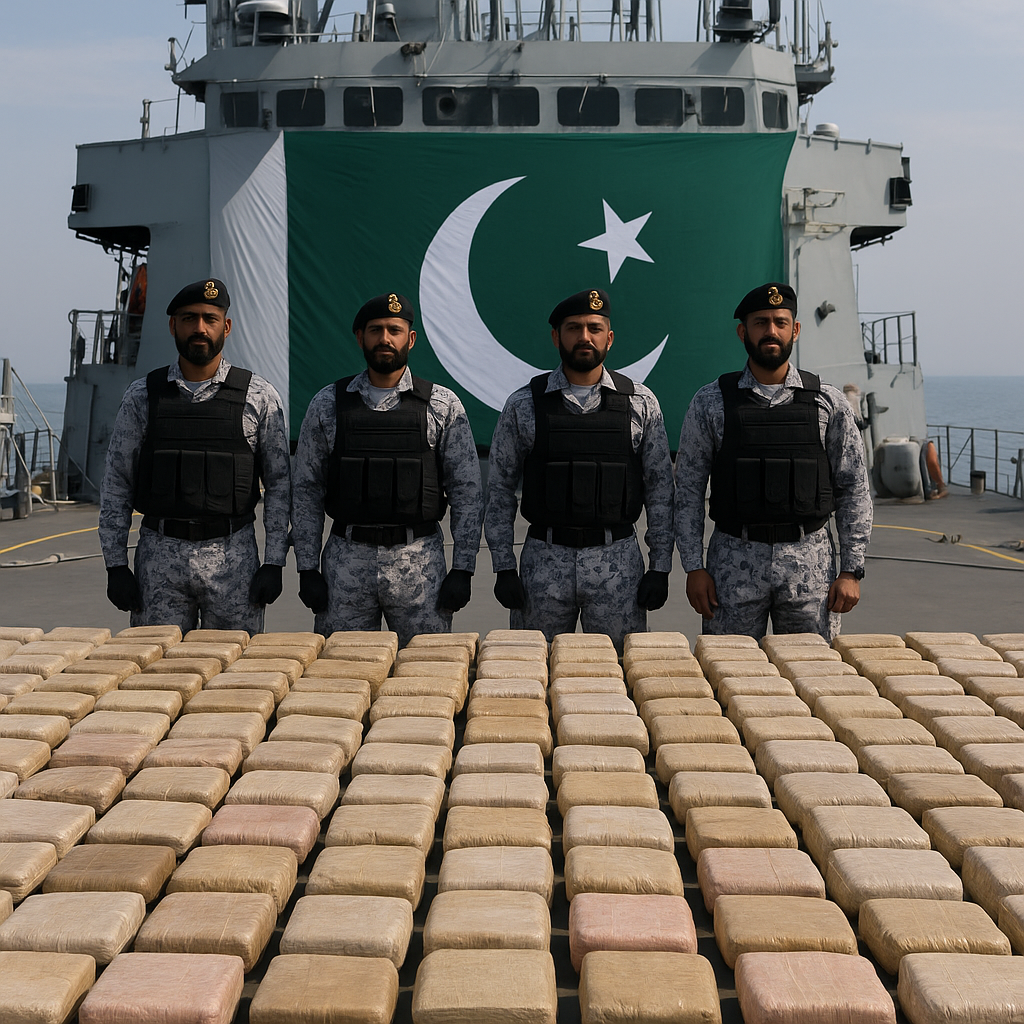
Pakistan Navy Seizes Nearly $1 Billion Worth of Drugs in Arabian Sea — A Historic Blow to Global Smuggling Networks
In a record-breaking anti-narcotics operation, the Pakistan Navy has seized drugs worth nearly $1 billion during a high-sea interception in the Arabian Sea. The mission, carried out under Combined Task Force 150 (CTF-150), marks one of the largest maritime drug busts in the region’s history, reaffirming Pakistan’s growing leadership in maritime security and international counter-narcotics operations.
A Bold Operation at Sea
Acting on precise intelligence reports, the Pakistan Navy ship PNS Yarmook conducted two consecutive operations in the North Arabian Sea, intercepting two stateless vessels suspected of carrying narcotics.
According to official briefings, both vessels were operating without identification, communication, or a flag — a clear violation of international maritime law. These vessels, locally known as dhows, are frequently used by international drug trafficking networks to transport illicit cargo across regional waters under the guise of fishing or trade.
Over a 48-hour period, the Navy’s boarding teams discovered an enormous quantity of narcotics, including crystal methamphetamine (ICE), heroin, and cocaine, hidden in multiple secret compartments on the boats.
- The first interception uncovered over 2 tonnes of crystal meth valued at approximately $822 million.
- The second interception, executed less than two days later, yielded 350 kilograms of meth and 50 kilograms of cocaine, with a combined street value exceeding $150 million.
The total seizure amounted to nearly $972 million, making it one of the biggest drug hauls ever recorded by Pakistan — and one of the largest by any navy in the Indian Ocean region.
Why This Operation Matters
This landmark operation is far more than a successful drug bust. It highlights Pakistan’s evolving role in global maritime law enforcement and reflects the increasing importance of maritime domain awareness in national security.
1. A Statement of Capability and Readiness
The operation proves that the Pakistan Navy possesses both the technological sophistication and the operational discipline to track, intercept, and neutralize high-value targets operating deep in international waters.
It also reflects the Navy’s growing integration with global maritime forces through the Combined Maritime Forces (CMF) — a coalition of 39 nations dedicated to promoting security and stability in the region.
2. Disrupting Global Narcotics Networks
The Arabian Sea has long been a major transit corridor for narcotics produced in Afghanistan and smuggled via Iran and Pakistan’s coastlines to Gulf states, Africa, and Europe.
The seized shipment likely belonged to a sophisticated syndicate operating across multiple countries — indicating that Pakistan’s success has dealt a severe blow to international drug cartels that rely on maritime smuggling routes.
3. Safeguarding Trade and Maritime Routes
Pakistan’s 1,000-kilometer coastline serves as a strategic hub for international trade through ports like Karachi and Gwadar.
By tightening control over these waters, Pakistan strengthens its position as a secure trade gateway and ensures that regional commerce remains protected from criminal exploitation.
Inside the Combined Task Force 150 (CTF-150)
This high-profile seizure was part of operations conducted under CTF-150, a multinational naval coalition operating under the Combined Maritime Forces headquartered in Bahrain.
CTF-150 focuses on counter-terrorism, counter-smuggling, and counter-narcotics missions across an area that spans over 3.2 million square miles, including parts of the Red Sea, Gulf of Aden, and Indian Ocean.
Pakistan has played an active and consistent leadership role in this task force, frequently commanding CTF-150 operations and contributing ships, aircraft, and personnel.
The success of PNS Yarmook demonstrates the effectiveness of Pakistan’s collaboration within this global naval alliance.
The Geography of Smuggling — Why the Arabian Sea Matters
The Arabian Sea sits at the intersection of South Asia, the Middle East, and East Africa — making it one of the busiest maritime zones in the world.
It connects critical global trade routes, including the Strait of Hormuz, through which nearly 20% of global oil shipments pass.
However, the same geography that makes these waters economically vital also attracts organized crime networks.
From Afghanistan’s narcotics production to African and European distribution markets, the Arabian Sea forms the perfect corridor for illegal maritime logistics.
Vessels without national registration — often wooden dhows — exploit these vast, lightly monitored zones to move drugs, arms, and humans with minimal risk of detection.
By intensifying its surveillance and interdiction capabilities, the Pakistan Navy has effectively closed key trafficking corridors in this complex maritime region.
Strategic and Political Implications
1. National Prestige and International Trust
The successful operation has boosted Pakistan’s image as a responsible maritime power.
It also strengthens its diplomatic standing among regional allies, including members of the Gulf Cooperation Council (GCC) and international maritime coalitions.
2. A Win for Maritime Intelligence
The precision of this operation reflects the Navy’s growing intelligence integration with regional and international partners.
It highlights how data sharing, radar surveillance, and aerial reconnaissance can neutralize criminal networks that rely on the ocean’s vastness to hide.
3. Strengthening Civil-Military Coordination
Such operations are not just naval victories — they involve coordination with customs, coast guard, and anti-narcotics forces.
This inter-agency success strengthens Pakistan’s internal security infrastructure and builds the foundation for a national maritime security framework.
Economic and Social Dimensions
Beyond the headlines, drug trafficking has deep social and economic consequences.
The global narcotics trade funds terrorism, organized crime, and corruption, threatening both governance and economic stability.
By eliminating this shipment, Pakistan has prevented billions in illegal profits from reaching criminal hands.
Moreover, major seizures like this one deter future smugglers and reinforce a culture of accountability across law enforcement institutions.
For Pakistan, it’s not just about securing waters — it’s about protecting its youth, economy, and international credibility.
The Human Element — Behind the Operation
The men and women aboard PNS Yarmook have been widely praised for their professionalism and courage.
Operating in unpredictable seas and often under challenging weather, these officers exemplify discipline, vigilance, and national pride.
According to Navy officials, such operations demand round-the-clock monitoring, rapid boarding drills, and technical testing of seized materials at sea.
Their success is a testament to years of investment in training, technology, and tactical excellence within Pakistan’s naval forces.
Challenges Ahead
Despite this historic win, the fight against maritime narcotics trafficking is far from over.
Criminal networks will likely adapt by diversifying routes, using smaller vessels, or deploying advanced concealment techniques.
Pakistan must continue to:
- Expand maritime surveillance through satellites, drones, and coastal radars.
- Enhance legal frameworks to prosecute smugglers under international law.
- Invest in inter-agency cooperation, linking naval intelligence with customs, FIA, and international counterparts.
By sustaining these efforts, Pakistan can transform this single victory into a long-term deterrent across the Indian Ocean region.
Conclusion — A Defining Moment for Pakistan’s Maritime Future
The Pakistan Navy’s seizure of nearly $1 billion worth of drugs in the Arabian Sea stands as a defining moment in Pakistan’s modern naval history.
It proves the nation’s commitment to securing global sea routes, disrupting organized crime, and protecting the integrity of international trade.
This operation sends a powerful message:
Pakistan’s waters will not serve as a highway for criminal activity — they are a shield of sovereignty, discipline, and global responsibility.
As Pakistan continues to evolve as a maritime nation, this operation will be remembered as the moment when its Navy not only guarded its coast — but safeguarded the seas themselves.