
Pakistan–Afghanistan Ceasefire: A Fragile Truce or the First Step Toward Regional Stability?
Introduction
On October 19, 2025, Pakistan and Afghanistan agreed to an “immediate ceasefire” following a week of deadly border clashes that left dozens dead and hundreds wounded. The truce, brokered in Doha through Qatari and Turkish mediation, aims to halt escalating violence and lay the foundation for lasting stability in a region long torn by mutual distrust and militancy.
Roots of the Conflict
The violence flared on October 11 after Pakistan allegedly conducted cross-border strikes in Kabul and Paktika, targeting groups linked to recent attacks inside Pakistan. In response, Afghan border guards returned fire along multiple frontier points, plunging ties to their lowest since the Taliban’s return to power in 2021.
Pakistan holds the Taliban government responsible for allowing Tehrik-e-Taliban Pakistan (TTP) and Balochistan Liberation Army (BLA) militants to operate from Afghan soil. The Afghan administration rejects this, claiming Pakistan exaggerates threats for political leverage. Yet Islamabad’s concern is supported by data: more than 2,400 deaths were recorded in militant attacks during the first three quarters of 2025 (CRSS).
Terms of the Agreement
Under the ceasefire:
- Both sides will respect each other’s sovereignty and territorial integrity.
- Cross-border terrorism “will cease immediately,” according to Pakistan’s Defence Minister Khawaja Asif.
- Follow-up meetings are planned for October 25 in Istanbul to form a verifiable monitoring mechanism.
- Neither side will target security forces, civilians, or critical infrastructure.
- Both countries pledged to resolve disputes through dialogue, not hostilities.
Zabihullah Mujahid, Taliban spokesperson, reaffirmed Afghanistan’s position that “Afghan soil will not be used against any other country,” echoing a message meant for both Islamabad and the broader international community.
Geopolitical Undercurrents
The Doha ceasefire is more than a bilateral truce — it’s a test of regional diplomacy.
- Qatar and Turkey, by facilitating dialogue, are asserting roles as peace brokers in South Asia.
- For Pakistan, the ceasefire offers relief from growing security and political pressure at home, as the public demands action against militant violence.
- For the Taliban government, participation lends much-needed diplomatic legitimacy amid economic collapse and international isolation.
Islamabad’s Deputy PM Ishaq Dar called it “the first step in the right direction,” but acknowledged that only a “concrete and verifiable monitoring mechanism” could sustain peace.
Why the Border Matters
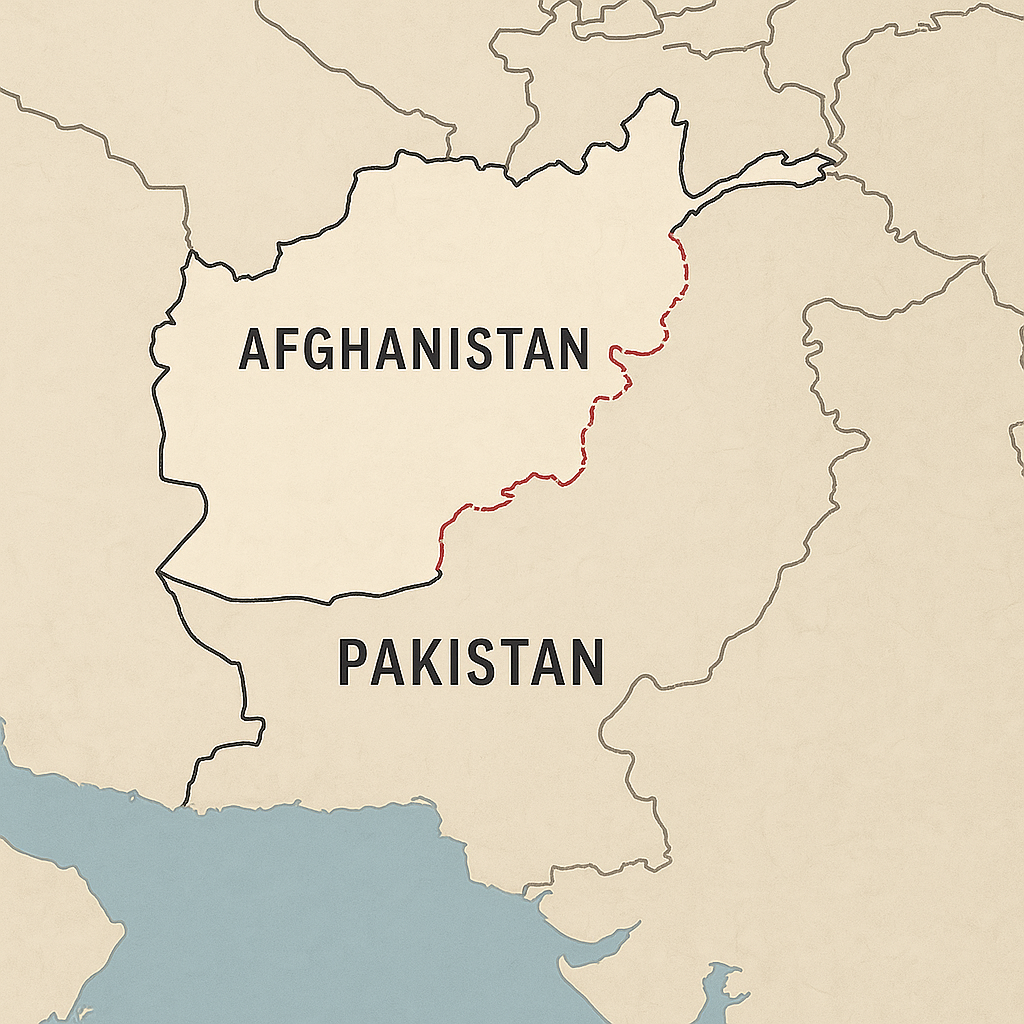
The 2,600 km Durand Line remains one of the world’s most volatile frontiers. For Pakistan, it defines sovereign territory; for Afghanistan, it’s a colonial remnant imposed in 1893. The dispute fuels recurring skirmishes and nationalist resentment.
Border regions — Khyber Pakhtunkhwa and Balochistan — bear the brunt of violence. Villages near Chaman and Spin Boldak have seen repeated shelling, drone strikes, and displacement. In Chaman alone, hundreds were injured in the October clashes, overwhelming local hospitals.
The TTP Factor
The ceasefire’s greatest test lies in controlling the Pakistan Taliban (TTP) — a network ideologically aligned with, but operationally independent from, Afghanistan’s Taliban.
Elizabeth Threlkeld, South Asia director at the Stimson Center, told Al Jazeera:
“The TTP and other groups aligned with it are not party to these talks. The onus falls on the Afghan Taliban to take action — and that’s going to be extremely challenging due to the porous border.”
Experts warn that even if Kabul intends to rein in militants, its control beyond major urban centers remains limited. Many TTP elements are embedded in tribal zones where Taliban influence is fragmented.
Pakistan’s Security and Political Stakes
For Islamabad, the ceasefire is a domestic necessity as much as a foreign policy move.
- The surge in militant attacks has strained Pakistan’s economy, hindered cross-border trade, and diverted military resources.
- Civilian morale in border provinces is low after years of conflict spill over.
- Politically, the government needs stability to focus on economic reforms and restore public confidence.
A sustainable peace could revive trade routes through Torkham and Chaman, strengthen Pakistan’s energy and logistics corridors, and reopen talks on regional connectivity projects with Central Asia.
Challenges Ahead
- Implementation Gap – Without a neutral verification body, accusations of violations could reignite clashes.
- Militant Autonomy – Non-state actors like the TTP and IS-K are not bound by state agreements.
- Historical Distrust – Decades of broken promises have eroded credibility between Islamabad and Kabul.
- Internal Fragility – Both countries face political and economic crises that could derail diplomatic focus.
Abdullah Baheer, a Kabul-based political analyst, notes:
“If Pakistan expects Kabul to rein in every TTP fighter, it’s unrealistic. The Taliban have limited control, and their governance challenges are immense.”
Scenarios for the Coming Months
- Optimistic: The Istanbul meeting finalizes an actionable monitoring body, and violence subsides across Khyber Pass and Balochistan.
- Moderate: Sporadic attacks continue, but both governments avoid escalation.
- Pessimistic: A large-scale incident collapses the truce, prompting retaliatory strikes and renewed hostilities.
Given past patterns, the middle ground seems most probable — a fragile calm overshadowed by uncertainty.
Conclusion
The Pakistan–Afghanistan ceasefire marks a rare diplomatic breakthrough in a volatile region. It carries the promise of de-escalation and mutual restraint, yet history cautions against optimism. Sustainable peace will depend not only on written commitments but on enforcement, regional coordination, and the political will to prioritize coexistence over confrontation.
For Pakistan, the ceasefire is a chance to refocus on internal stability and regional trade. For Afghanistan, it’s an opportunity to show responsible governance and international maturity.
Whether the truce becomes a turning point or another short-lived reprieve will depend on what happens after October 25 — when words must finally meet action.